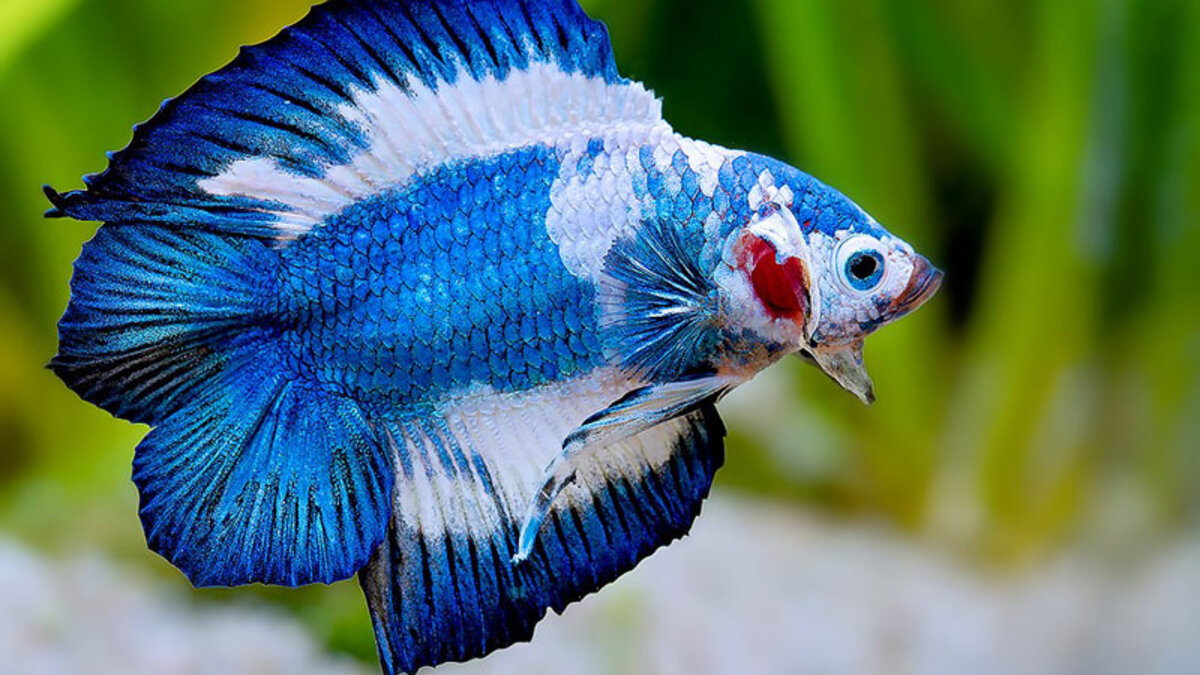
Species Focus: Betta Splendens, the Fighter of a Thousand Colours
The Betta splendens, commonly known as the "Siamese fighting fish", is arguably the most recognisable freshwater fish in the world. With its spectacular fins that ripple like silk veils and a colour palette that rivals the most beautiful corals, the Betta has fascinated aquarists for centuries.
But behind this beauty lies a fish with a strong personality, specific needs that are often misunderstood, and a fascinating history. This complete guide will help you understand, choose, and keep a Betta in the best possible conditions.
A Bit of History
The Betta splendens originates from Southeast Asia — Thailand, Cambodia, Laos, Vietnam, and Malaysia. In the wild, it lives in rice paddies, shallow ponds, ditches, and floodplains. These habitats share one thing in common: calm, warm, and often oxygen-poor waters.
It's precisely this constraint that shaped one of the Betta's most remarkable features: its labyrinth organ. This auxiliary breathing organ, located in the gill cavity, allows it to breathe atmospheric air directly from the surface. This is why you'll regularly see a Betta rise to gulp a bubble of air — it's not a sign of stress, it's perfectly normal.
The first Betta breeding dates back to the 19th century in Thailand (then Siam), where they were bred for fighting — hence the nickname. Today, selective breeding has shifted towards beauty, producing dozens of varieties with extraordinary shapes and colours.
Betta Varieties
By Fin Type
- Halfmoon (HM): the caudal opens to 180°, forming a perfect semicircle. The most spectacular and popular show variety.
- Crown Tail (CT): fin rays extend beyond the membrane, creating a spiky "crown" effect. Highly distinctive.
- Plakat (PK): short fins, closer to the wild form. More lively and agile than long-finned varieties. Excellent health.
- Double Tail (DT): two distinct caudal lobes, very developed dorsal. Unique shape but more fragile.
- Dumbo/Elephant Ear: oversized pectoral fins resembling elephant ears. Endearing swimming style.
- Veiltail (VT): the most common form in pet shops. Long, flowing caudal fin. Hardy and easy to keep.
- Over Halfmoon (OHM): caudal exceeds 180°. Impressive but can cause swimming difficulties.
- Rose Tail: fin rays are so branched that the caudal resembles rose petals. Stunning but fragile (heavy fins).
By Colour and Pattern
- Solid: a single uniform colour (red, royal blue, white, black, yellow...)
- Bicolor: body one colour, fins another
- Butterfly: concentric colour bands on the fins
- Marble: irregular marbled pattern that can change over time (jumping gene)
- Galaxy/Koi: multicoloured spots reminiscent of koi carp
- Dragon: thick, metallic scales on the body, often white or silver
- Copper: metallic coppery reflections across the entire body
- Mustard Gas: dark blue/green body with mustard-yellow fins
Ideal Care Conditions
The Tank
This is the most important and most misunderstood point. A Betta does not live in a glass or a vase. Despite its ability to survive in small volumes, surviving is not living.
| Parameter | Minimum | Ideal |
|---|---|---|
| Volume | 15 litres | 20-40 litres |
| Temperature | 24°C | 25-27°C |
| pH | 6.0 | 6.5-7.5 |
| GH | 4 | 5-15 |
| KH | 2 | 3-8 |
| Filtration | Yes (gentle) | Filter with reduced flow |
| Heating | Essential | Adjustable thermostat |
Fundamental Rules
- No strong current — the Betta's long fins act like a sail, exhausting it in a powerful flow. Use an adjustable-flow filter or break the current with a sponge.
- A lid is mandatory — Bettas are excellent jumpers. Without a lid, you'll find yours on the floor.
- Consistent warmth — the Betta is a tropical fish. Below 22°C, its metabolism slows, its immune system weakens, and it becomes vulnerable to disease.
- Hiding spots — floating leaves, plants, decorations. The Betta needs resting zones and a sense of security.
- No sharp decorations — Betta fins are fragile. Avoid hard plastic plants, sharp rocks, and decorations with rough edges.
Ideal Plants for a Betta Tank
Bettas love planted tanks. Plants provide hiding spots, reduce stress, and improve water quality.
- Anubias nana: hardy, grows on wood or rock, broad leaves for resting
- Java Moss: forms cosy cushions, ideal for bubble nests
- Cryptocoryne: various sizes, shade-tolerant, very well suited
- Pistia / Salvinia: floating plants that filter the light (Bettas prefer moderate lighting)
- Catappa (Indian Almond Leaf): releases beneficial tannins, simulates the natural habitat
Feeding
What Does a Betta Eat?
The Betta is a carnivore/insectivore. In the wild, it feeds on insects, mosquito larvae, and small crustaceans. Its aquarium diet should reflect this.
Recommended Menu
- Daily staple: quality Betta-specific pellets (Hikari Betta Bio-Gold, Fluval Bug Bites, New Life Spectrum)
- 2-3 times a week: live or frozen food — bloodworms, brine shrimp, daphnia
- Occasionally: live mosquito larvae (an absolute treat!), cyclops
Golden Rules
- Small portions — a Betta's stomach is about the size of its eye. 2-3 pellets twice a day is enough.
- One fasting day per week — aids digestion and prevents constipation (a common issue)
- Vary the diet — monotony weakens the immune system
- No flakes — Bettas have upward-facing mouths (surface feeders). Floating pellets are far better suited.
Tankmates: Friend or Foe?
The Male Betta Alone
The basic rule: never two male Bettas together. Ever. It's a fight to the death (or at minimum, shredded fins and permanent stress).
Possible Companions
Some fish can cohabit with a male Betta, under certain conditions:
- ✅ Corydoras: peaceful, bottom-dwellers, ignored by the Betta
- ✅ Otocinclus: discreet algae eaters
- ✅ Snails (Neritina, Ramshorn): the Betta generally ignores them
- ✅ Amano Shrimp: large enough not to be eaten (but risky with an aggressive Betta)
- ⚠️ Rasbora: possible in a school of 8+ in a tank > 60L, but the Betta may stress them
- ❌ Male Guppies: colourful fins = rival in the Betta's eyes
- ❌ Aggressive fish (barbs, cichlids): they will attack the Betta's fins
- ❌ Red Cherry Shrimp: too small, will be hunted and eaten
Female Bettas
Females are less aggressive than males and can cohabit in groups of 5 or more in a well-planted tank of at least 60 litres (the "sorority tank"). Caution: not all females accept this arrangement — close monitoring is required.
Breeding
Betta breeding is a fascinating spectacle but requires preparation.
The Bubble Nest
The male builds a bubble nest at the surface — a cluster of small bubbles coated in saliva that will serve as a nursery. This is a sign the male is ready to breed. Some males build nests even without a female present.
The Process
- Conditioning (1-2 weeks): abundant live food for the pair
- Visual introduction: the female in a clear container inside the male's tank — they can see each other but not touch
- Release: when the female shows vertical bars (sign of receptivity), release her
- The courtship: the male displays, spreads his fins, the pair circles each other
- The embrace: the male wraps around the female beneath the nest — she releases her eggs, he fertilises them
- Collection: the male collects each egg in his mouth and places it in the bubble nest
- Remove the female: immediately after spawning, remove the female (the male becomes aggressive to protect the nest)
- Incubation: the male tends the eggs alone for 24-48 hours
- Hatching: the fry remain attached to the nest for 2-3 days before swimming freely
Feeding the Fry
- Days 1-3: fry absorb their yolk sac (do not feed)
- Days 3-10: infusoria, micro-worms (Vinegar eels, Walter worms)
- Days 10-30: freshly hatched brine shrimp nauplii
- 30+ days: finely crushed food, then pellets
Common Diseases
Fin Rot
The most common disease. Fins progressively deteriorate from the edges.
Causes: poor water quality (90% of cases), stress, injuries
Treatment: frequent water changes (30% every 2 days), aquarium salt (1g/L), in severe cases: antibacterial medication (Esha 2000, API Melafix)
White Spot Disease (Ichthyophthirius)
Small white spots like grains of salt on the body and fins.
Treatment: gradually raise temperature to 30°C + malachite green treatment or Esha Exit
Velvet (Oodinium)
Golden/rusty powdery appearance on the body, often confused with ich.
Treatment: total darkness (the parasite is photosynthetic) + copper-based treatment + elevated temperature
Dropsy
Severely bloated belly, scales raised like a "pinecone". Unfortunately often fatal.
Prevention: impeccable water quality, varied diet, no overfeeding
The Betta: More Than a Fish, a Personality
What makes the Betta so endearing, beyond its beauty, is its character. Every Betta has its own personality:
- Some are curious and come to greet you when you approach the tank
- Others are shy and hide behind plants
- They recognise their carer and can be "trained" (follow a finger, jump for food)
- They explore their environment with intelligence and method
- Some like to rest on broad leaves, others prefer the surface
The Betta is a fish that forms a bond with its owner. That's rare among fish, and it's what makes it such a special companion.
Our Recommendations for Beginners
- A 20-30 litre tank — heated, gently filtered, planted
- A single male — enjoy his beauty without risking fights
- Quality food — varied (pellets + live/frozen)
- Regular water testing — the Blue Freshwater app helps you track your parameters
- Patience — let the tank cycle for 3-4 weeks before introducing your Betta
- Observation — every Betta is unique, get to know yours
The Betta splendens is living proof that a small, well-designed tank can house a creature of extraordinary beauty and personality. Give it the conditions it deserves, and it will repay you a hundredfold with its displays, colours, and endearing character.
This article is part of our Species Focus series. Find all our detailed guides on freshwater and marine species on the Blue blog.