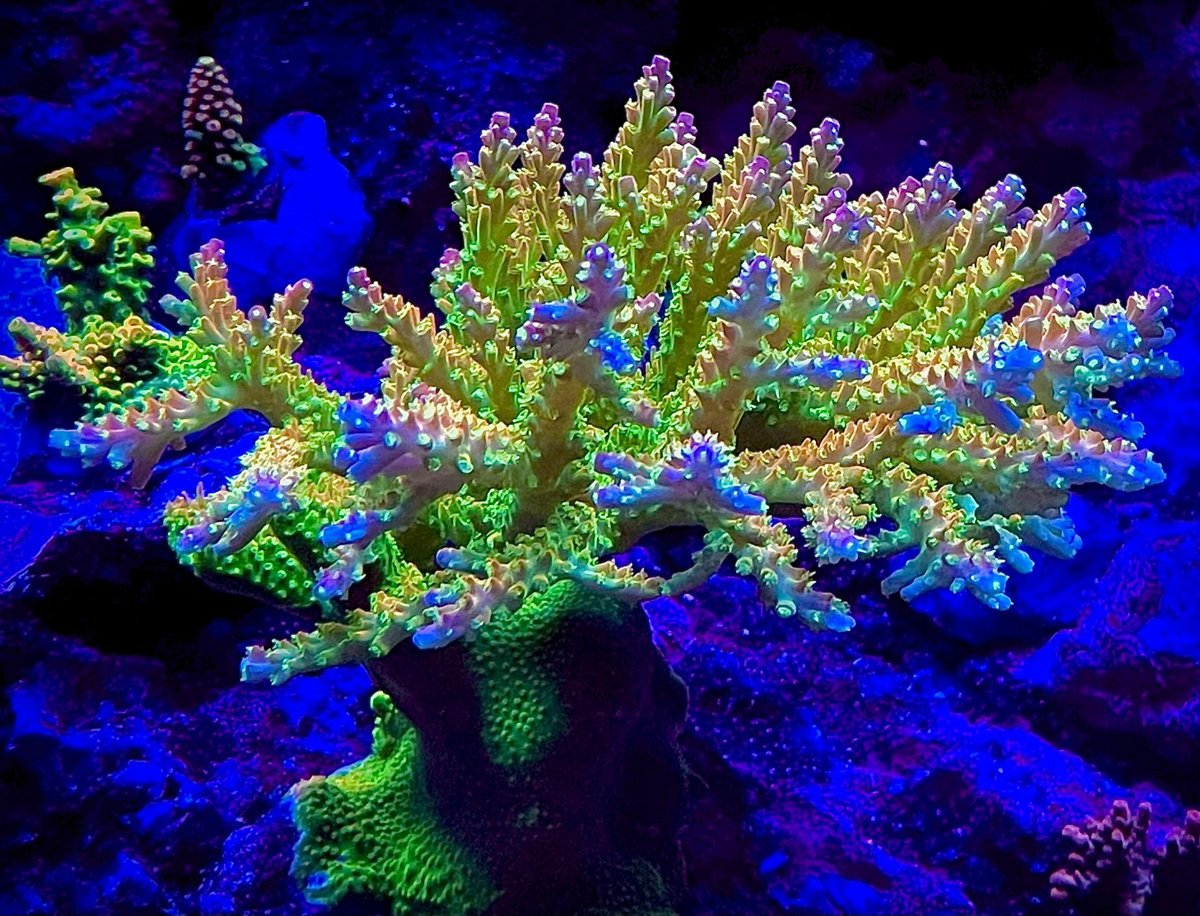
Species Focus: Acropora, the Undisputed King of SPS Corals
For many reef hobbyists, successfully maintaining an Acropora-dominated tank represents the Holy Grail of marine aquarium keeping. These Small Polyp Stony (SPS) corals embody both the raw beauty of tropical reefs and the ultimate technical challenge. Their branching, tabletop, and digitate growth forms, combined with a color palette ranging from candy pink to electric blue, make them the most prized — and most feared — inhabitants of our reef aquariums.
This comprehensive guide gives you the keys to understanding, selecting, and successfully keeping Acropora, whether you're an experienced reefer ready to take the plunge or an enthusiast curious about why these corals captivate so many.
What is an Acropora?
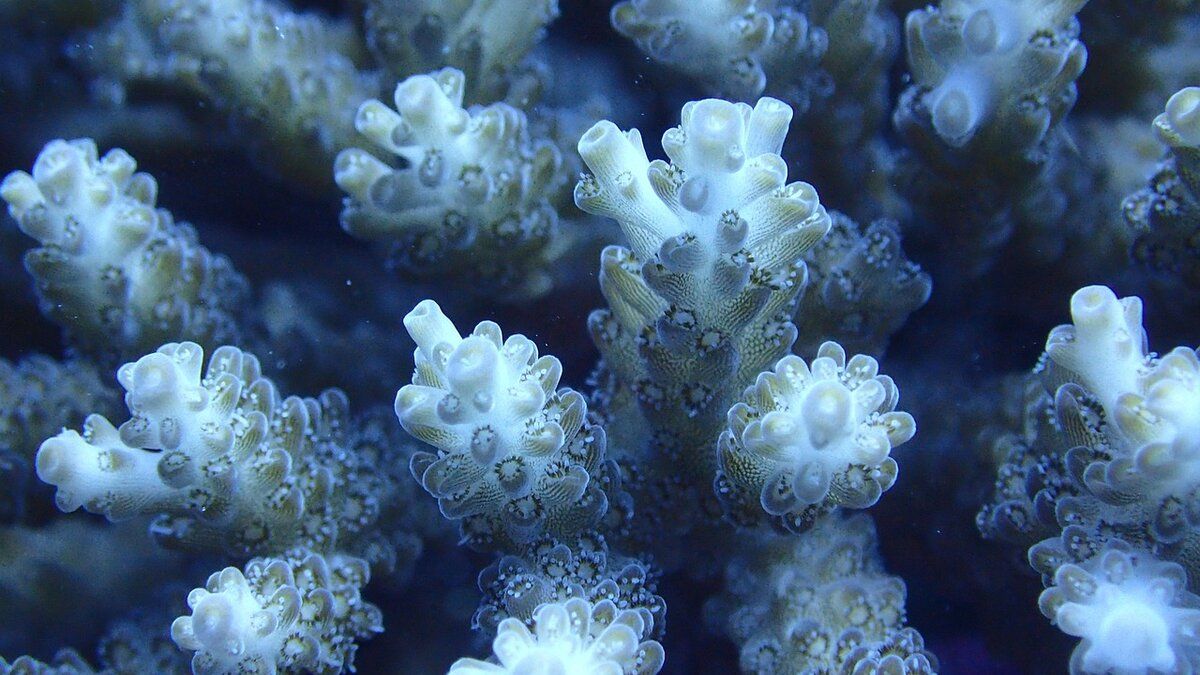
The genus Acropora belongs to the family Acroporidae and encompasses over 150 described species, making it the most diverse coral genus on Earth. They're found in virtually every tropical reef ecosystem, from the Pacific to the Indian Ocean, the Red Sea to the Caribbean (with the species A. cervicornis).
Acropora are hermatypic corals — they build the reef itself. Their aragonite skeleton grows rapidly (often 1-3 cm per month under ideal conditions) thanks to a symbiotic relationship with zooxanthellae, unicellular algae living within their tissue that provide most of their energy through photosynthesis.
Morphological characteristics
- Axial corallites: a terminal polyp at the tip of each branch, responsible for apical growth
- Radial corallites: lateral polyps along the branches, varying in shape between species
- Coenosteum: the skeletal tissue between corallites, whose texture is a key identification criterion
- Growth forms: branching (arborescent), tabletop (table), digitate, hispidose, bottlebrush, staghorn...
Star Species in the Hobby
Acropora millepora
Arguably the most popular Acropora species in the hobby. A. millepora features short, compact branches with prominent tubular radial corallites giving it a "fuzzy" appearance. It comes in an astonishing variety of color morphs: green, pink, blue, orange, red, bicolor... Australian variants (ASD — Australian Show Display) command premium prices.
Difficulty: Moderate to high — relatively hardy for an Acropora, a solid choice for your first foray into the genus.
Acropora tenuis
The collector's favorite. A. tenuis develops thin, elegant branches with small, regularly-spaced radial corallites. Its colors are often spectacular: the "Walt Disney," "Miyagi Tort," and "Crayola" morphs are legendary.
Difficulty: High — more sensitive to fluctuations than millepora, demands very stable water.
Acropora nasuta
Recognizable by its nose-shaped radial corallites (hence the name), pointing toward the branch tips. Often forms open bushy colonies. Green and pink morphs are most common, though blue varieties exist.
Difficulty: Moderate — a good introduction to the genus, relatively forgiving.
Acropora valida
An underrated classic. A. valida forms compact, ramified colonies with relatively thick branches. Often green or brown with purple or blue tips, it's robust and fast-growing.
Difficulty: Moderate — excellent for SPS beginners.
Acropora humilis
Characterized by short, thick digitations, almost finger-like. Solid, resistant to intense flow, it's naturally found in high-energy surge zones on the reef.
Difficulty: Moderate — very hardy, ideal for getting started.
Acropora tortuosa
The iconic "Tort." Thin, twisting branches with relatively slow growth but intense colors (deep blue, purple). The "Oregon Tort" variety is a sought-after classic.
Difficulty: High — slow growing, sensitive to fluctuations.
Acropora hyacinthus
The king of tabletop forms. This species creates horizontal plates that can exceed one meter in diameter in the wild. In aquariums, it produces spectacular structures but requires ample space and intense, even lighting across its entire surface.
Difficulty: High — needs a spacious tank and powerful, uniform lighting.
Acropora echinata
Nicknamed "bottlebrush" for its branches bristling with long, thin tubular corallites. A unique and unmistakable appearance. Often green or blue with contrasting tips.
Difficulty: High — slow growing, sensitive.
Lighting: The Number One Factor
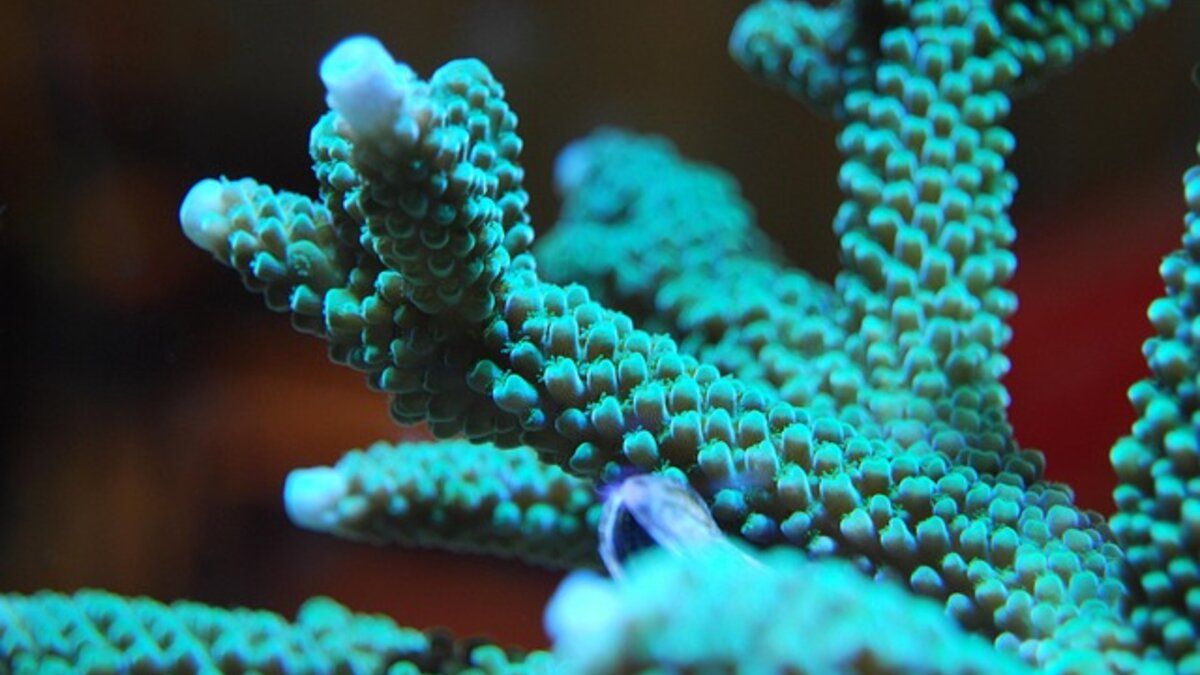
Acropora are full-light corals. In nature, they dominate the most sun-exposed zones, often in the first few meters of depth. In the aquarium, lighting is the single most important parameter for their health and coloration.
Required intensity
- Recommended PAR: 300-500 µmol/m²/s at coral level
- Minimum: 250 PAR — below this, colors fade and the coral stretches toward light ("stretching" morphology)
- Maximum: 600+ PAR — some shallow-water Acropora tolerate very high PAR, but watch for photobleaching
Light spectrum
- Blue base: 420-460 nm — essential for fluorescence and coloration
- Supplementary: violet (400-420 nm), cyan (470-495 nm), and a touch of white (14,000-20,000K) for photosynthesis
- Avoid: too much warm white (< 10,000K), which promotes algae and dulls coral colors
- Modern LEDs (Radion, AI Hydra, Reef Factory) allow fine spectral control — aim for a "blue-dominant" spectrum with 70-80% blue/violet channels
Photoacclimation
Golden rule: always acclimate gradually. An Acropora placed directly under intense lighting risks stress-related photobleaching. Follow this protocol:
- Place the frag in the mid-zone of the tank (PAR 150-200)
- Gradually raise it to its final position over 3-4 weeks
- Or use a diffusion screen that you progressively remove
- Observe: paling colors = too much light, browning = not enough
Flow: Simulate the Reef
Flow is the second pillar of Acropora husbandry. These corals naturally inhabit high-energy zones — reef slopes, crests, and channels — where current is powerful and chaotic.
Why flow matters
- Gas exchange: delivering O₂ and removing CO₂ at the tissue level
- Nutrition: microparticulate food is delivered to the polyps
- Waste removal: mucus and sediment are cleared, preventing necrosis
- Skeleton: strong flow stimulates denser, stronger skeletal growth
Recommended turnover
- Target: 40-80 times the tank volume per hour in total flow
- For a 130-gallon (500L) tank: aim for 5,000-10,000 GPH of flow
- Flow type: chaotic and alternating — avoid continuous laminar flow which creates dead spots
- Pumps with "reef" mode (Gyre, Tunze, EcoTech Vortech/MP) with random patterns are ideal
Positioning
- Acropora branches should gently sway in the current
- Polyps should be able to extend without being flattened
- If mucus or sediment accumulates between branches → insufficient flow
- If polyps never open → flow too direct or too strong, redirect
Water Parameters: Stability Above All
This is where Acropora reveal their demanding nature. More than perfect numbers, it's absolute stability that determines success or failure.
Target parameters
| Parameter | Optimal Value | Tolerance |
|---|---|---|
| Temperature | 77-79°F (25-26°C) | 75-80°F (24-27°C) |
| Salinity | 35 ppt (1.026 SG) | 34-36 ppt |
| pH | 8.1-8.3 | 8.0-8.4 |
| KH (Alkalinity) | 7-9 dKH | 7-11 dKH |
| Calcium (Ca) | 420-440 ppm | 400-450 ppm |
| Magnesium (Mg) | 1300-1350 ppm | 1250-1350 ppm |
| Nitrate (NO₃) | 2-5 ppm | 0-5 ppm |
| Phosphate (PO₄) | 0.01-0.03 ppm | < 0.03 ppm |
| Potassium (K) | 380-400 ppm | 370-410 ppm |
| Strontium (Sr) | 8-10 ppm | 7-12 ppm |
Critical points
- Stable KH: daily KH variation should not exceed 0.5 dKH. This is the single most critical parameter. A KH swinging between 7 and 10 throughout the day is more dangerous than a steady 7.5.
- Ca/KH/Mg ratio: these three elements are chemically linked. Magnesium that's too low prevents calcium and KH from remaining stable.
- ULNS vs DNS: the "Ultra Low Nutrient System" vs "Dirty" debate rages on. In practice, Acropora color best with nutrients very low but detectable (NO₃ 1-3, PO₄ 0.01-0.02). Strict zero NO₃ and PO₄ often leads to bleaching from zooxanthellae loss.
- N:P ratio: aim for a Redfield ratio of approximately 16:1 (NO₃:PO₄ by mass). An imbalanced ratio causes problems even when individual values appear fine.
Supplementation
- Calcium reactor: the most stable method for large SPS-dominant tanks — maintains Ca, KH, and pH simultaneously
- Balling method: separate dosing of Ca, KH, and Mg via dosing pumps — excellent control but requires regular monitoring
- Kalkwasser (limewater): ideal supplement via ATO (auto top-off), boosts pH and precipitates phosphates
- Trace elements: iodine, potassium, strontium, iron, manganese — dose sparingly and test regularly (ICP-OES analysis recommended every 2-3 months)
Growth and Coloration Tips
Promoting growth
- Feeding: contrary to popular belief, Acropora benefit from targeted feeding. Use foods in the 10-100 µm range (phytoplankton, coral powder, amino acids) 2-3 times weekly.
- Amino acids: amino acid supplements (Red Sea Reef Energy, Fauna Marin, Korallen-Zucht) stimulate growth and intensify colors. Start with low doses.
- Activated carbon: replace regularly (every 3-4 weeks) to maintain crystal-clear water — light penetration is essential.
- Water changes: 10% weekly with quality salt (Tropic Marin Pro Reef, Red Sea Coral Pro, Fauna Marin) replenishes trace elements and dilutes pollutants.
Optimizing coloration
The spectacular colors of Acropora result from a subtle balance of several factors:
- Chromoproteins: non-fluorescent pigments (red, purple, blue) are stimulated by intense UV/violet light
- Fluorescent proteins: greens, cyans, and certain pinks are GFP-like proteins activated by blue light
- Zooxanthellae: too many → brown coral; too few → bleaching. Balance is adjusted via light + nutrients
- Pro tip: slight light stress (PAR at the upper limit) combined with low (but non-zero) nutrients pushes corals to produce more "sunscreen" chromoproteins → more intense colors
Fragging
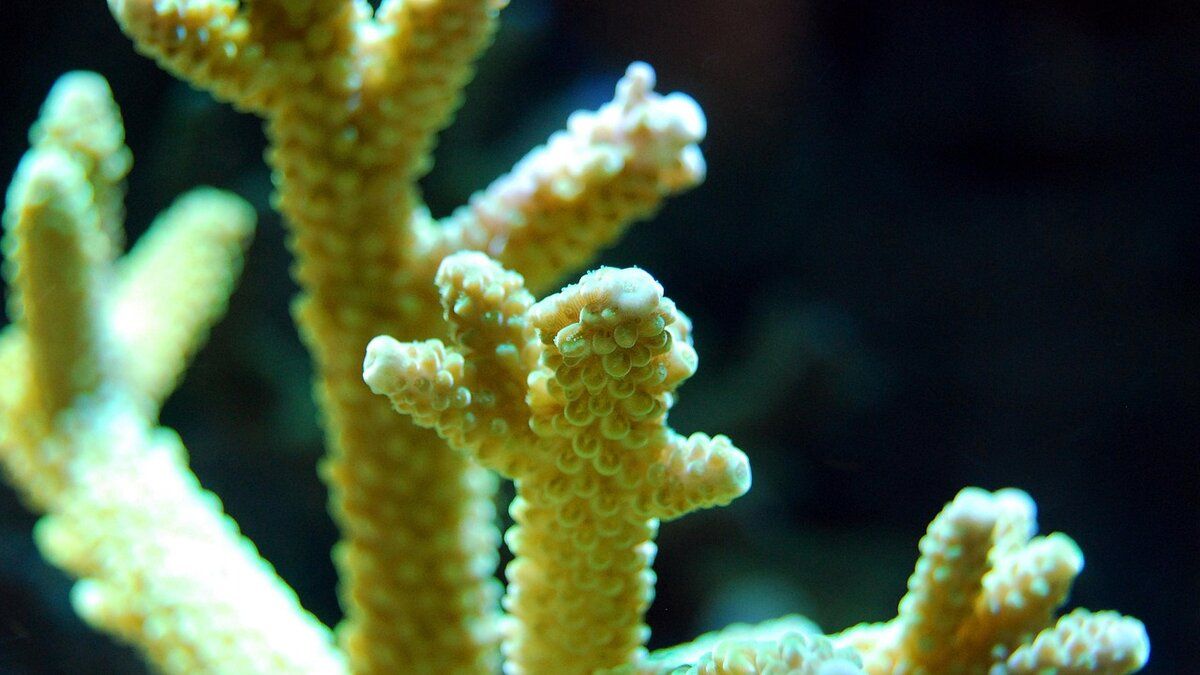
Fragging Acropora is relatively straightforward and is an excellent way to propagate your colonies, share with fellow reefers, or create "insurance" backups of your favorite strains.
Equipment needed
- Bone cutters or coral band saw (Gryphon)
- Gel cyanoacrylate glue (superglue gel)
- Ceramic or aragonite frag plugs/discs
- Frag tank or rack in the main tank
- Lugol's iodine for disinfection (optional)
Technique
- Select a healthy branch with good coloration and active polyps
- Cut cleanly at the base of the branch with the bone cutters — avoid crushing the skeleton
- Minimum size: 2-3 cm (about 1 inch) of frag — smaller pieces have lower survival rates
- Glue to the plug with superglue gel — hold for 10 seconds out of water
- Place in the mid-zone of the tank (moderate PAR) for 2 weeks
- Gradually move to the final position
- Encrusting onto the plug typically takes 2-4 weeks
Pro tips
- Frag preferably in the morning when polyps are retracted
- Avoid fragging a stressed coral or one showing RTN/STN
- Frags heal within 24-48 hours — a thin white film over the cut is normal
- Dip in diluted Lugol's (5 drops/L for 5 minutes) to prevent infection
- Don't frag more than 20-30% of the mother colony in a single session
Common Problems and Solutions
RTN — Rapid Tissue Necrosis
Every SPS keeper's nightmare. RTN manifests as extremely rapid tissue loss (hours), typically starting from the base and moving toward the tips. White skeleton appears within hours.
Possible causes:
- Sudden KH swing (> 1 dKH in 24 hours)
- Temperature crash
- Chemical contamination (spray, paint, nicotine on hands)
- Bacterial stress (Vibrio sp.)
Emergency action:
- Immediately remove the affected coral
- Frag surviving tips above the necrosis line
- Dip in concentrated Lugol's or Coral RX
- Urgently test all parameters
STN — Slow Tissue Necrosis
The "slow" version of RTN. Tissue loss progresses over days to weeks, often from the base. Less catastrophic but equally fatal if untreated.
Causes:
- Chronically unstable water parameters
- Chemical warfare from other corals (allelopathy)
- Shaded zones or low-flow areas at the coral base
- Parasites (Acropora Eating Flatworms — AEFW)
Solutions:
- Identify and address the root cause
- Cut or dremel away necrotic tissue to halt progression
- Improve flow around the colony
- Check for parasites
AEFW — Acropora Eating Flatworms
These microscopic flatworms (Amakusaplana acroporae) are the bane of Acropora collectors. Nearly invisible to the naked eye (2-5 mm, translucent), they graze Acropora tissue, leaving characteristic "bite marks."
Detection:
- Circular light-brown bite marks on tissue
- Localized color loss
- Eggs: small white dots at branch bases (visible with magnification)
- Test: dip a fragment in RO water — worms detach and become visible
Treatment:
- Dip in Flatworm Exit, diluted Bayer Insecticide, or CoralRX
- 3 treatments at 5-7 day intervals to break the egg cycle
- Mandatory quarantine of all new Acropora for 2-3 weeks with treatments
- Natural predators: some wrasses (Halichoeres, Pseudocheilinus) consume AEFW
Red Bugs (Tegastes acroporanus)
Tiny red copepods (< 1 mm) visible on Acropora surfaces. They don't kill directly but stress the coral, reduce polyp extension, and dull colors.
Treatment:
- Milbemycin oxime (Interceptor): the classic treatment, effective in a single dose
- Remove all crustaceans first (shrimp, hermit crabs, crabs)
- Re-dose after 2 weeks as a precaution
Bleaching
Loss of zooxanthellae turns the coral white or translucent. This isn't instant death — the coral can survive several weeks without its symbionts — but it's a major alarm signal.
Causes:
- Temperature too high (> 82°F / 28°C for several days)
- Light too intense without acclimation
- Nutrients too low (NO₃ and PO₄ at strict zero)
- Chemical stress
Recovery:
- Reduce lighting by 30-40%
- Stabilize temperature
- Slightly increase nutrients (target NO₃ 2-3 ppm)
- Feed more (amino acids, phyto)
- Recovery takes 4-8 weeks if the coral isn't too weakened
The Ideal Acropora Tank
Volume and configuration
- Recommended minimum: 80 gallons (300L) — but 130+ gallons (500L+) offer far better stability
- Open top: promotes gas exchange and easy access
- Overflow + sump: essential for housing technical equipment
- Oversized skimmer: choose one rated for 1.5-2x your actual volume
Recommended equipment
- Lighting: high-end LED or T5 hybrid — minimum budget $500-800 for a 130-gallon setup
- Flow: 2-4 powerheads with controller (random modes)
- Skimmer: high-performance and reliable (Bubble King, Nyos, Red Sea)
- Calcium reactor or dosing pumps (3-5 channels minimum)
- ATO: auto top-off to stabilize salinity (fluctuations = stress)
- Controller: pH, temperature, conductivity monitoring (GHL, Apex, Reef Factory)
- ICP-OES testing: comprehensive water analysis every 2-3 months
- Chiller or fans: essential in summer to prevent thermal spikes
Patience: Your Greatest Ally
An SPS-dominant Acropora tank takes time:
- 0-6 months: cycling, setup, live rock maturation — no Acropora yet
- 6-12 months: introduce first hardy SPS (Montipora, Seriatopora, then beginner Acropora like humilis or valida)
- 12-24 months: the tank is mature, parameters dialed in — time for more demanding species (tenuis, tortuosa)
- 24+ months: the reef flourishes, colonies grow, colors explode
Why Acropora is the Ultimate Challenge
Successfully keeping Acropora means mastering simultaneously every aspect of reef aquarium keeping:
- Water chemistry: understanding Ca/KH/Mg interactions, nitrogen cycle, trace elements
- Physics: lighting, spectrum, hydrodynamics
- Biology: coral-zooxanthellae symbiosis, nutrition, interspecific competition
- Engineering: reliable equipment, redundancy, monitoring
- Patience: accepting that results are measured in months and years
It's a demanding, expensive, and sometimes frustrating hobby. But when a tank full of multicolored Acropora thrives under intense blue light, with polyps extended catching the light like tiny underwater flowers… it's an incomparable reward.
Acropora isn't simply a coral. It's a living fragment of the reef in your living room, a constant reminder of the beauty and fragility of our oceans, and proof that patience, discipline, and passion can recreate a small miracle of nature.
This article is part of our Species Focus series. Find all our detailed guides on popular marine species on the Blue blog.